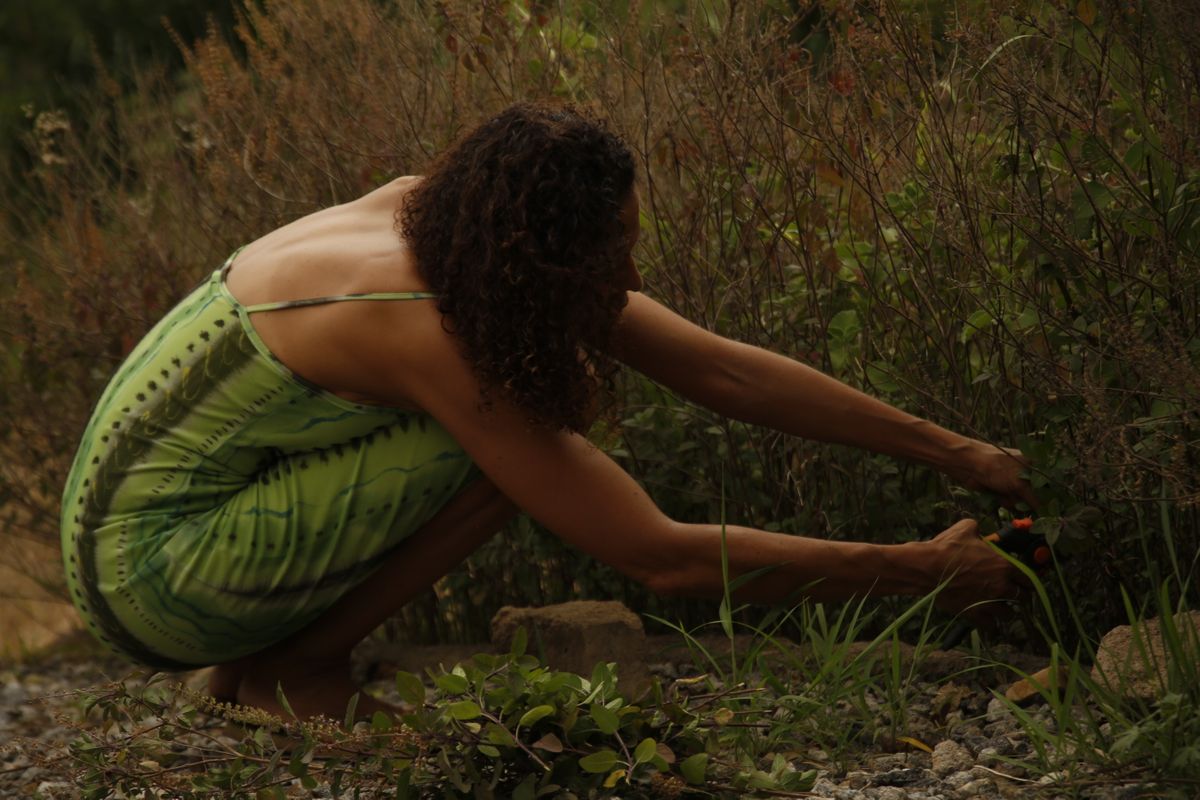
Lisa C Soto was born in Los Angeles, and is based between Puerto Rico and Ghana. Soto’s work weaves photography, installation and sculpture with the botanical universe. Her multi medium, large-scale installations and convivial settings reimagine landscapes, cartography and rhizomatic patterns to explore connections and disconnections to nature and the notion of home.
Soto is currently in the doctorate program at KNUST, Kumasi, Ghana in the painting and sculpture department. She has exhibited in galleries and museums and installed a permanent public installation in Newark, NJ commissioned by Adjaye Associates, as well as lectures to institutions including MIT, Ford Foundation and Rutgers University.
Artist Statement
My practice rethinks microcosms, cartographies, universes, and force fields through three-dimensional works, rhizomatic sculptures, gardens of tropical plants and foods, and immersive installations that lead viewers into movement. These works create tension while simultaneously emphasizing connectivity.
The work questions the construction of artificial differences and the establishment of borders, while exploring the forces at play within the macrocosm. I am interested in shaping what these energies, frequencies, and vibrations might look like when made tangible. Convivial gatherings, photo transfers, and installations situated in both architectural and natural environments propose movement from one “state of being” into another.
At its core, the work strives to remake worlds and universes—creating environments in which the exchange of energy fields and knowledge, both ancestral and contemporary, can be experienced and activated by the viewer. Viewers are not passive observers but participants within these shifting systems.
These ideas are explored through a wide range of materials, including photography; industrial materials such as wire, Mylar, and hardware; sound, smell, and movement; and natural materials like earth, compost, seeds, roots, and plants. Through interactive installations, viewers are converted into participants, becoming part of the work’s evolving ecology. Drawing on references such as cartography, tropical forests, cosmic networks, geometric patterns, and decentralized systems, the work is ultimately less about matter than about what the void can birth—and the continual potential for transformation.
- Lisa C Soto